Wednesday, March 21, 2012

post-mortem of a flood

pot's on fiyah! the beginnings of a celebratory gumbo...a tad premature?
perhaps so, but that never stopped us from celebrating before.....


It's nearly 9:00am, and steadily raining – well, more like something between a drizzle and a rain. It's coolish (62F) and breezyish (5mph from the west) . . . perfect weather and a perfect time to put a pot of celebratory gumbo on the stove.


Some of you will remember the previous post on this blog (13 March), along with the facebook message I put out yesterday (20 March) detailing the ongoing saga of 12 March 2012's 10-15" Big Rain here just north of Lafayette. One week into the wake of the flood, and a number of us living just east of Bayou Vermilion are still boating to the blacktop (North Wilderness Trail, running atop Bayou Vermilion's east bank).

Yesterday, we were growing mighty anxious about the weather forecast calling for more deluge-type storms today. Presently, even though it's still raining, it appears we've dodged a cannonball, as the main squall line blew through 6:30-7:30 this morning, dropping only 1.25” more water up this way.

"crazy lil' thing, crazy lil' thing, how'd you get a name like crazy lil' thing?
prob'ly the name that drove you crazy, all along..." 
(quote by Captain Beefheart, photo by Russ Norwood http://www.perceptivist.com/)


As previously mentioned, even though it's still raining, we're partying. And we're not alone. Outside, the local chickadees didn't even wait for the deluge to end before breaking out into courtship songs. No mere calls, vaguely uttered, but fancy show-off courtship songs (a quasi-strident, “See-see See-Saw” repeated at frequent intervals. . . you know a chickadee's feelin' happy when he's singing this song). Presently, Carolina wrens and cardinals have joined in, piercing the cool drizzly air with songs of love.

So I'm like, “What the hey! There's no time like the present . . .Gumbo Party!”

Living most of my life down here along the Gulf Rim, I've noticed that most Gulf Rimmers pass time by generally just sitting around waiting for a reason to celebrate; and that down here in Cajunland our celebrations often turn out to be just a tad premature. Oh well. Better to have celebrated in vain than not to have celebrated at all, vous connais?

Anyway, it looks like 1-3" or so inches this go round is not going to seriously hamper the progress of our Big Drain. In fact, I'm hopeful that we'll be driving to our homes by Sunday (25 March). If that's the case, then we'll have boated for 13 straight days – one day shy of our record of 14 boat days, set during the May 2004 Mega Flood.

I asked for prayers in yesterday's facebook update. The responses from my friends were interesting. Some seemed taken aback that I'd even suggest that “God” would/could push the forecast rains elsewhere. After all, isn't that “childish at best and selfish at worst” type thinking? Well, no. Not to a believer. And yes, after decades of studying every spiritual belief system proposed by humankind, I remain an old-school Jesus-believer. By the same token, I certainly don't expect anyone else to believe like I believe.


(photo by Larry Amy or Kevin Courville . . . or possibly, both)

Sometimes it seems the real childishness and selfishness of it all lies in the notion that we can actually find human words to satisfactorily describe What's Going On. Truly, It's beyond all that, else it wouldn't be “God.” I mean, if we humans could actually define “God,” that ain't saying much for “God,” you know?

On David Byrne & Brian Ferry's mid-70s record album, “My Life in the Bush of Ghosts” the preacher man said, “....He's so HIGH, you can't get over Him; He's so LOW, you can't get under Him; He's so BIG, you can't get around Him....”


(photo by Edward Watson)


Pardon me if this seems personal, but How big is your God? Does God fill your Universe? Might God go beyond the Universe as well? Can God fill you? To the point where it becomes your heart, and not your mind, that speaks and acts and runs your show? These are good questions to ponder. . .

So, grateful thanks to all those who prayed for us, all those who thought about us, and all those who directed dry vibes our way. . . and as always, to God.

Now on to the Celebratory Gumbo. Like my spiritual beliefs, it's an old school recipe. Old school southern Evangeline parish chicken & sausage gumbo. With a twist. Unlike the gumbos of Lafayette & New Orleans, “cajun prairie gumbo” is thinner – closer to carmel-brown than chocolate-brown. This is accomplished by simply adding a little more water. Emphasis on “a little.”

A thinner gumbo reveals way more complexity of flavor than a thick one. That's because roux is so powerful that it easily masks the more delicate flavors of the meat and vegetables. So you dilute it, and whoa! The taste.

So I start with about 2 cups of dark roux mixed with about a quart of water and a quart of chicken stock. Heat only to a simmer while stirring (to keep the roux from sticking to the bottom of the pot) in order to dissolve all the roux. Once fairly well dissolved (a half-hour) turn fire lower, and add 2 chopped onions, 1 chopped bell pepper, a couple of tablespoons of minced garlic, and 3-4 ribs of fine-chopped celery.

Initially, I season with about 1 rounded teaspoon of black pepper, 1 rounded tablespoon of cayenne pepper, and 2 rounded tablespoons of salt. Toward the end, I recheck seasoning, adding more if necessary. Be careful with the salt, however, as chicken stock can have a lot; and you really want to use chicken stock in this thing.

Add another quart of chicken stock and another quart of water (now you've got a total of 1 gallon of water/stock invested) and turn up the fire to a slow, rolling boil.

After about 45-60 minutes, add 1lb. sliced smoked sausage (I use turkey, but southern Evangeline parish tradition calls for pure pork) and 1 hen, cut-up. Then 1-2 cups each of chopped onion tops & flat parsley. Keep it on a slow roll for another 2-3 hours, adding water to replace that which has steamed off (that keeps it thin!), and you're almost done.

Turn off the fire and let cool for an hour, allowing the oil from the roux & chicken & sausage to float/pool up to the surface. Skim as much of this oil off as you can, using either a big spoon or soup ladle. Then check seasoning, adding if necessary, and add another cup each of chopped onion top and parsley. Now you're done!

So “my twist” I guess is in adding celery and in “double-adding” onion top and parsley. The result is a super-fine, hearty-yet-very-digestible, veggie-tainted gumbo. It's health food I tell you.

Wednesday, March 14, 2012

anatomy of a flood

"....and i wonder; still i wonder....."


Blame it on youth, I guess; but when Lydia and I moved back here in northern Lafayette parish on the Bayou Vermilion floodplain 30 years ago, flooding was the last thing on our minds. We'd been living out in the woods in various places since 1978, and by 1982 we were looking to put down roots for good. The joys of living in quasi-wild places apparently outweighed any concerns we might have had regarding flooding. Blissful ignorance.


We moved out here for good in August 1982. We experienced our first flood in January 1983. On that occasion we didn't even know enough to move our vehicles up to the blacktop, and ended up relatively stranded back here with one other intrepid couple for 11 days. We all worked 8 to 5 jobs. Fortunately, one of us was out working when it flooded, so we had one (tiny) vehicle with which to carpool. We scored a small aluminum boat to ferry us from our homes to the blacktop, and there you have it.


Fast-forward 30 years, and the big flood of March 12 represents the 19th flood we've endured back here. The other couple's long gone; and numerous other couples/families have come and gone as well. But we're still here – as Robbie Robertson put it, “...for the crime of having no where to go...” and I guess we've grown used to it by now.


For the record, this past flood was not the worst. Our home itself has only flooded on a couple of occasions: Hurricane Andrew in 1992, and The Great Prairie Basse Flood of May 2004, when we had 14” of water in our living room for 8 miserable days. This time around, the living room caught a little water during the peak of the deluge; but only for an hour or so.


Over the years, I've never had the time to “journal” a flood event back here. But since retiring from the 9 to 5 grind 4 years ago, I did have the time to do so for this flood. Below, then, is “Anatomy of a Flood.” Hope ya'll enjoy.

11 March 2012, 10:00 a.m. – Perusing the weather channel, I saw where one of the Hawaiian Islands had experienced 48” of rain over the past week. This caused a very brief flashback to May 2004 when we received 20-30” here in one week's time.

12 March 2012, 7:00 a.m. – Awakened to heavy rain and near-constant window-rattling thunder. Whoa. This got me to flashing back to May 2004 all over again. Outside our bedroom window, the rain gauge had 1.5” in it, and rising fast.

8:00 a.m. – Nervously drinking coffee with Lydia on the front porch. The back porch is our preferred coffee spot, but the roof overhang is only 4' there – not near enough to keep us dry. Here on the front porch we've got 8' of roof. As the rain poured, neither of us brought up any talk about floods. After coffee I flicked on the weather channel, only to be greeted by a “FLOOD WARNING FOR PARTS OF ACADIA, LAFAYETTE, and ST. LANDRY PARISHES.” Checking the rain gauge, I note that in one hour we've gained 1.25” for a total of 2.75” Now I'm thinking quite a bit about our flood history.

9:50 a.m. – We've got a 5” max on our rain gauge, so I had to go out and empty it, as it has now reached 4.0” and the rain's coming down harder than ever. Praying now.


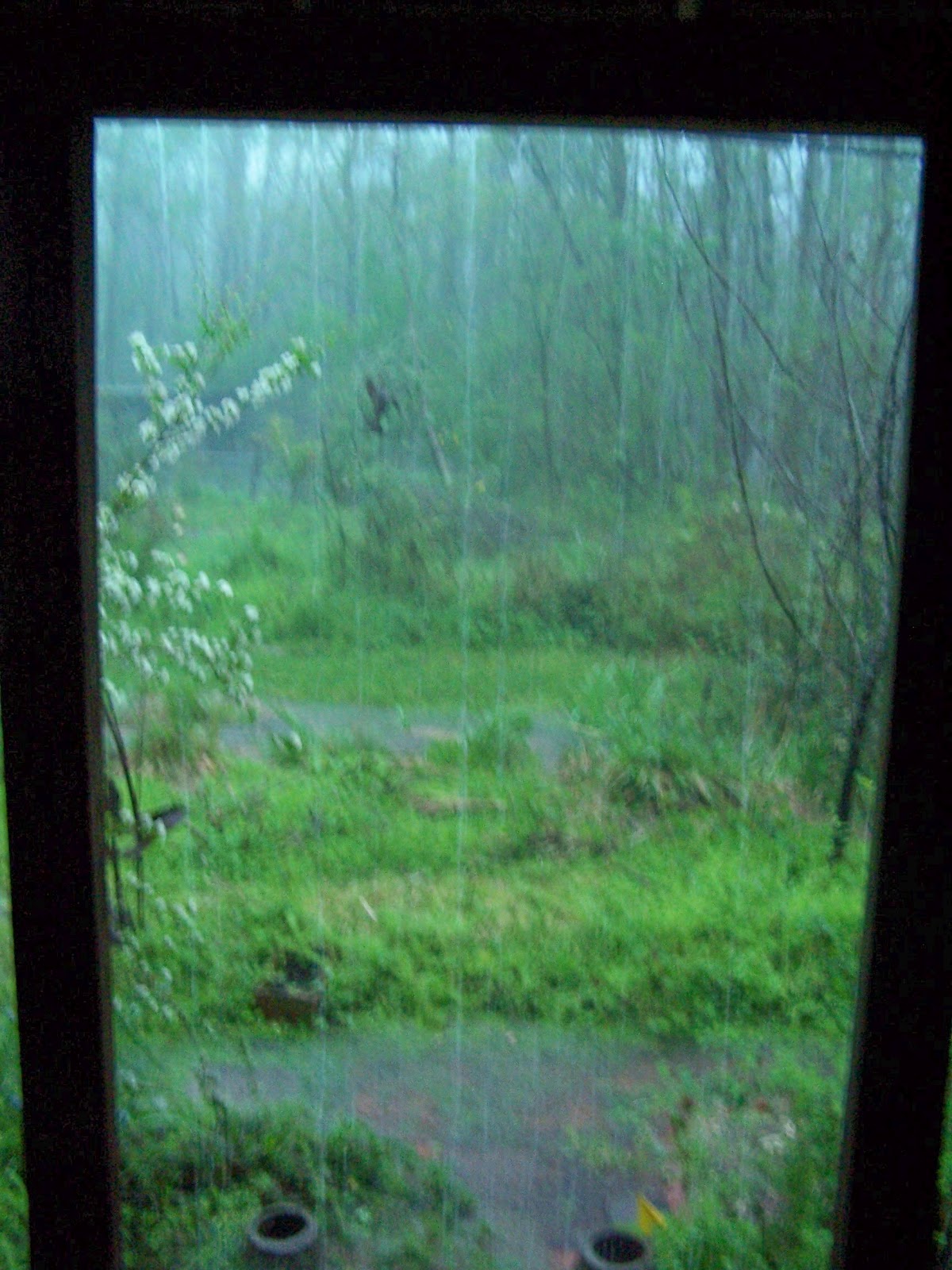
10:02 a.m. – Taking this picture through the back door, I happen to glance at the rain gauge. It says 1.0” . . . what? In 12 MINUTES?!!?? So it's 5” in 4 hours. Oh my. At this point I realize that our road's going to go under pretty quickly.


going under...

10:20 a.m. – With our total now approaching 7” I know it's time to move our vehicles up to the blacktop. It's a half-mile trip and we'll have to walk back in this deluge. Lydia balks, lobbying to wait until the near-constant lightning/thunder eases up. Sorry. The water ain't waiting on us.


handy-dandy Megalo-mart mesh flood shoes

10:40 a.m. – Returning from the blacktop we were wading through about 6-10” of water on the road. I take a look at the rain gauge 7.75”

10:50 a.m. – As the rain gauge hits 8.25” weather channel radar shows an angry thunderstorm complex sort of disorganizing right over us. It doesn't seem to be moving away, but instead is just growing eastward toward Breaux Bridge and Henderson.


11:05 a.m. – I dejectedly go out to empty the rain gauge again. We've just gotten our first break in the rain in nearly 5 hours. Local weather reports I-49 shut down between Opelousas and Carencro, so it's no uber-surprise when I note water creeping into our living room. Fortunately, the break in the deluge came at just the right time. A few towels and a mop soak up the living room water, and I note that the water in our garage has gone down to almost nothing.


front garden going under....note 7' foot bridge on the move behind the bird bath

2:00 p.m. – After an unsuccessful attempt at a nap (constant window-shaking thunder is back), I hurry out and reposition/stake-down our foot bridge, which has floated off its base. Several floods ago I learned to do this, rather than attempt to yank a few hundred pounds of foot bridge back where it belongs, post-flood. Yes! I am capable of learning, water-logged brain and all . . .

Flashback: January 1983. It must have been like Day 8 of our first flood. Lydia and I are in the boat, and we're enjoying our first “light moment” in, like, 8 days. At this point, she tactfully reminds me that we don't want to look back on this episode with nothing but bad memories, because as time goes on, all you really have that's worth anything is memories. Wow. Oh yeah, Give her a chance, and Lydia can spout some wise stuff . . .


Roseate Spoonbill & friend

And thinking more on it, I realize that some of our most wonderful “nature” moments have come during the floods. Even during the evil May '04 episode, we recorded our first-ever Roseate Spoonbill and Black-bellied Whistling Duck back here.

6:30 p.m. – After a 3-hour break (from deluge to hard drizzle), here comes another gully-washer. Constant window-rattlin' thunder now to our south ('twas from the north all day). Local news showed pandemonium-level flooding in Carencro (5 mi. due west of us). Rain total presently stands at 9.5”

water attempting to sneak into living room via carport


7:30 p.m. – This last deluge just ended. 1.9” in 1 hr. bringing our total to 11.4” for the day. Thank God it ended when it did, for water was threatening the living room just as it ended. I'm thinking of friends up the road (behind the original Don's Specialty Meats) who caught 2' of water throughout their house by around noon. They only recently moved there, and the original owner had told them that the house never once flooded in the 40 years that he lived there. Wait a minute. We're the ones (idiots) living right on the floodplain. It is amazing to look back over 19 floods here and realize that we've lost only two living room floors (we've got ceramic tile now....duh....) and had to gut the living room only once. Other than that, it's been a downright charming existence.


our gravel road...Wilderness Trail Rd. is about a quarter-mile off in the distance...water depth ca. 4.5'
on 13 March 9:30 a.m.

Just heard that water from Bayou Vermilion is now over-topping Wilderness Trail Rd (the blacktop) and flowing back toward us. Not a good thing. A record crest is expected sometime tonight. During the May '04 flood, water gushed over Wilderness Trail for 5+ days, raising the level back here to within one skinny inch of our main floor. With the bayou crest from this event coming so quickly (tonight), I doubt that we'll get that kind of backwater. Time will tell.

Wednesday, February 22, 2012

spring done sprang...

fresh this morning...brand-new strawberry bush (Euonymus americanus) foliage


"Behold: all things are become new..."
                                                                                      
                                                                                        -- 2 Corinthians 5:17


softly..........slowly...........

Spring came creeping in over the Mardi Gras weekend, meek, mild, and inspirational as ever. Living back in the Bayou Vermilion floodplain, I couldn't help but note the contrast between our garish celebration – round numbah 12,032 [or thereabouts] in our own perpetual search for self-validation – versus Spring's brand of celebration, which by its mere presence, becomes validation for all things, including us po' humans.


back porch view:  wild geranium, oxalis, rain lily, , spiderwort, bedstraw carpet
below; freshly-expanding leaves of deciduous holly, rough-leaf dogwood, and elderberry above.
you can't see the seed feeders very well (against the smaller of Lydia's old rehab pens), but an older male Chipping Sparrow stubbornly remained there -- refusing to abandon his breakfast buffet -- hotly "chipping" his protest as i approached to within 15' to take this picture.


Here in the low woodlands, the arrival of Spring 2012 has brought its usual sachel of pleasantly-lukewarm temperatures, days-in-a-row of rains or threats of rains, along with the resultant clouds of mosquitoes, the evil carpenter bee, the fantastically-fresh flowers of the early-spring bloomers, and today, the promising apprearance of the first new leaves of our deciduous plants. Soon, the hollow-echoing sound of winter will be replaced with the gently-muffled softness of spring. Heck, cardinals, chickadees, titmice, wrens, mockingbirds – even hawks – are hollering their lungs out for hours a day.

rain lily blooms sneak thru a chubby clump of spiderwort garlanded with bedstraw


the venerable old Cherrylaurel (almond-scented leaves!), fronted by
'Old Blush' the first antique rose variety brought in to the U.S. (ca. 1750)


The blooms of local early-spring plants, yes, we wait for those; but it is the unfurling of the first leaves of the year that really raise the hairs on the back of my neck, you know? The sudden near-wall-to-wall appearance of vibrant yet somehow soft hues of green, along with their accompanying textures, is almost startling. As of this morning, numerous local trees are now leafing out: pawpaw, red buckeye, sweetgum, black willow, deciduous holly, rough-leaf dogwood, and strawberry bush. 
 
The sounds of the birds and the long lost buzzing of flying insects echo through the warmish moisture-laden air. It's all almost too much to take in. Almost.
 
The pictured rain lily species is Zephranthes candida (aka "zephyrlily"), a South American native which has naturalized around Louisiana a good bit. Other natives currently in bloom include mayhaw (Crataegus opaca/aestivalis), blue phlox (Phlox divarcata), dewberry (Rubus trivialis), and little-leaf viburnum (V. obovatum).
 
little-leaf viburnum is a wetland species; this one is some sort of
dwarf cultivar (can't remember its name)
 
 
Spring down here along the Gulf Rim is hard to beat. Within a couple of weeks, you'll have to almost get out of the way as the bird, bug, and bloom/foliage parade picks up steam. As we say here in Cajunland, "Get out and get you some!"

Monday, February 6, 2012

mardi gras maple

Samaras of Acer rubrum var. drummondii


Genetic variation...some plants got it, some don't. Here in the southeastern U.S. for example, white oaks look pretty much the same wherever they are found. Ditto for southern red oaks. On the other hand, water oaks show lots of genetic variation in leaf margin/shape. Ditto for delta post oak (Quercus similis).


American Robins feasting on "standard" Yaupon Holly fruits
(photo by Stephen Pagans)

And then there are species such as yaupon holly (Ilex vomitoria), which exhibits big-time differences in leaf size, branching patterns, growth habit, fruit color, etc., often within single locales!

By the way, the UL-Lafayette campus and nearby Ira Nelson Horticulture Center on Johnston Street in Lafayette, may still host a substantial number of holly variants; for back in the golden age of horticultural research (1950-80) there, a number of UL horticulture professors were collecting, hybridizing, and test-planting all sorts of hollies, native and exotic. Dr. James Foret, for example, found a female yaupon out in the wild with pendulant branch growth which he named 'Folsom's Weeping' Yaupon, a plant which is still in the nursery trade today.


"Swamp Red Maple" (Acer rubrum var. drummondii)

Red maple (Acer rubrum ssp.) is another native species exhibiting tons of variation, mainly in leaf shape and pubescence, fruit size and color, and winter foliage color as well – so much so that it has been subdivided into three distinct botanical varieties: red maple (A. rubrum var. rubrum ), Drummond's red maple (A. rubrum var. drummondii), and (no common name) A. rubrum var. trilobum; each of these varieties occurring in discreet populations throughout the species' eastern U.S. range. Moreover, even within each varietal population, substantial variation is regularly observed in the wild.

Drummond's red maple (Acer rubrum var. drummondii), locally known as “swamp red maple,”  is heavily distributed throughout Louisiana's “brown water” swamps and bottomland hardwood habitats. Able to thrive alongside bald cypress and tupelo gum in even permanently-inundated swamps, swamp red maple is one of the most common trees within south-central Louisiana's Atchafalaya Basin – said to be the largest remaining river swamp in North America. Compared to the leaves of the “standard” red maple (Acer rubrum var. rubrum), swamp red maple leaves feature densely pubescent undersurfaces – so much so that the undersurfaces appear silvery-white – whereas the undersurfaces of the former almost completely lack pubescence and appear nearly the same hue of green as the upper surfaces. Too, swamp red maple leaves are mostly three-lobed (as opposed to mostly five-lobed in red maple), with lobes featuring very shallow “toothing”(as opposed to deep/irregular toothing in red maple).

Acer rubrum var. drummondii
loaded with samaras


Coming into bloom each January, swamp red maples are soon adorned with clusters of large, long-stemmed, two-winged fruit capsules known as samaras. By February samara production reaches its peak, resulting in tree branches heavily-hung with samara clusters in colors ranging from paper-bag-brown to flesh pink to pink-mauve to ruby-red to ox-blood-red.


Note Samara Color Variations Among These Four
Randomly Selected/Randomly Planted Specimens

Many years ago, it was none other than Dr. James Foret who suggested that we capitalize on this local February spectacle, and advertise a “Mardi Gras Maple Tour” across the Atchafalaya Basin during the Mardi Gras season, when so many tourists are hanging around in south Louisiana. Dr. Foret reasoned that since we do not have the annual “in-your-face” fall foliage color show celebrated in northern states, why not focus on the nearly-as-spectacular “sort-of-in-your-face” early-spring samara color show – focused particularly in the Atchafalaya Basin where 1) swamp red maples are abundant, and 2) many tourists are traveling between New Orleans and Lafayette in order to catch both “city” and “country” cultural flavors of our Fat Tuesday celebrations.

In essence, Dr. James Foret was suggesting one of Louisiana's first eco-tourism events.

Alas, the idea never did gain traction in any official capacity. But then again, hooray(!); as swamp red maples care not whether their fruiting season is celebrated by humans or not . . . they just go on fruiting February after February.

Suggestion: Take a drive on I-10 across the basin this month. Stop off at the fine tourist center at Butte LaRose. Celebrate our Mardi Gras Maple season for yourselves.

And hey, never underestimate the visual power of our swamp red maple winter foliage color season. It comes late – usually not beginning in earnest until mid-December, and peaking somewhere around Christmas give-or-take a week. Regarding winter foliage color, we have a patch of swamp red maple living in the understory of a smallish grove of green ash trees directly across from our house. Over the years I've noticed that winter foliage color varies not only from tree to tree, but also from winter to winter within individual trees! Below are winter foliage pictures that I've accumulated from this small colony over a period of several winters. 

19 December 2005


05 December 2011


05 December 2011


10 December 2009

Friday, January 13, 2012

queen sugarberry

Sunrise on Hackberry Row
Upper Lafayette Parish, Louisiana
13 January 2012


What a symphony out back this morning! It was still below-freezing when I brought my coffee out onto the back porch. The sun had just risen, and new rays were bouncing like mad off of the ashy-gray trunks of the hackberry trees. Dozens upon dozens of robins and cedar waxwings were feasting up at the tops of the hackberries, with dozens and dozens of hackberry seeds pinging off of the tin roofs of Lydia's old mammal enclosures (she functioned as a wild mammal rehabber for many years). The steady seed-pinging laid down the rhythm, upon which many robins overlaid with their joyful spring courtship songs. The cedar waxwings and house finches provided background vocals.


ping! ping! ptweet! ptweet! ping! ping! ptweet! etc.


I mean, what could I do? I had to report this to you, gentle readers.

Called “sugarberry” by foresters and some botanists, the hackberry is an amazingly adaptive tree, possessing a U.S. range spanning the entire continent from Atlantic to Pacific to Gulf Coasts (see http://plants.usda.gov/java/profile?symbol=CELA). Right here in the south-central U.S. hackberry occupies habitats disparate as the mucky bottomland hardwood forests of Louisiana's Atchafalaya Basin to the water-starved clay hills around Dallas.

Earlier this winter – back in early November, when leaves were still on most of the trees – I predicted that due to the drought of 2011, this winter's hackberry crop would probably hover somewhere between sub-par and awful. Turned out I was wrong. Thankfully so. Beginning sometime around the first week of December, robins began descending into the large hackberry grove that borders the northern and eastern edges of our homesite. This went on for weeks. By Christmas, flocks of cedar waxwings and eastern bluebirds had joined the massive robin flocks. Today (13 January) they're still working it like mad. Upon closer inspection of the now leafless trees, I noticed (through binoculars) that the hackberry crop is, if anything, heavier than normal, but that the berries are noticeably smaller. Smaller but, to the great delight of the robins, sweeter. Alrighty then!


American Robin: munchin' & ptweetin'

Within the ecosystems in which they occur, hackberries are major players in providing winter calories for wild birds and mammals. Here in Louisiana, for example, we conducted a 5-year statewide bird frugivory survey in the latter half of the 1990s. Regarding diversity of bird species utilizing the fruits, hackberry ranked numero uno of the 50 species of berry-producing plants observed, serving 27 different bird species.


Hackberry (Celtis laevigata, aka "sugarberry")

As previously mentioned, the hackberry has been nicknamed “sugarberry” due to the sweetness of its berries. Actually, the berries hold very little pulp. Each berry is enclosed in a rather thick, sweet-tasting husk, underlain by a thin, orange-colored, insipidly-sweet, slimy layer of pulp surrounding a large seed. Given the miniscule amount of pulp involved in each berry, it follows that birds need to eat lots of hackberries in order to obtain nutritional benefit – mammals, even more. And eat them they do, in vast quantities. Lydia and I have seen both raccoons and fox squirrels as well as birds such as yellow-breasted chats eating unripened hackberries as early as August.


sugarberries: shucked, unshucked, half-shucked


In Edible Plants of the Gulf (see http://www.nativeventures.net/books.php) Louisiana botanist Charles Allen wrote that native Americans used hackberries for sustenance as well, grounding the entire berries to use as a flavoring. In Trees, Shrubs, and Woody Vines of Louisiana Allen reports that Indians used the bark of hackberry to treat sore throat and venereal diseases.

Hackberry is an elm family (Ulmaceae) member; and like its close cousins, the elms, its wood is not much good for anything – not even for firewood. Yep. Somewhat useless to contemporary white folks; priceless to wildlife. . . that's sort of the way it goes.

Friday, December 23, 2011

hedge-row birding


hedgerow at edge of harvested sugar-cane field
16 December 2011, Lafayette parish, LA


Ecotones are places where two or more different habitat types meet. Ecotones are known for high rates of plant and animal diversity, since they most often contain plants and animals from both/all of the involved habitat types. Woodland edges – where forests meet with other habitat types such as prairies, meadows, marshes, etc. – are fine local examples of ecotones.


Similarly, agricultural hedgerows are artificially-generated systems that mimic woodland edges in both structure and species composition. Structurally, hedgerows are linear thickets, usually about 25' in height and width, and densely-packed with trees, shrubs, and vines.


hedgerow flanking a small water course
20 December 2011, Acadia parish, LA

From a bird perspective, hedgerows represent super-safe areas where songbirds can rest and eat in near total concealment. A concealed songbird is a happy bird; and a concealed songbird surrounded by ample food resources is a super-happy bird. Ultimately, a concealed songbird surrounded by ample food and water resources is a blissfully-happy bird!

Hedgerows snake through agricultural lands of all makes and models. Here along the southern Gulf Coastal Plain of the U.S., hedgerows are most often comprised of trees such as water oak, rough-leaf dogwood, hollies, hawthorns, prickly-ash, and cedar; shrubs, like elderberry, viburnums, beautyberry, palmetto, and Chinese privet; and vines, including blackberry, catbrier, moonseed, honeysuckle, poison ivy, and wild grape. Tons of cover and tons of juicy berries.

Rusty-blackhaw Viburnum fruits


Rough-leaf Dogwood fruits


parsley hawthorn fruits
(photo by Annette Parker)


poison ivy fruits


Here in watery Louisiana, agricultural hedgerows flank small bayous, coulees, and artificial irrigation canals and ditches, nicely completing the ultimate food/cover/water formula sought by all wildlife.

Birding along hedgerows is usually very very good, especially during the fall/winter months, when berry production is at its peak, and most of the foliage has fallen, allowing for easier viewing. Following the law of the ecotone – or “edge effect” as it is more commonly known, hedgerow bird communities are very diverse, and include numerous species of hawks, doves, woodpeckers, flycatchers, vireos, wrens, thrushes, mimic thrushes, warblers, sparrows, and others. Let's take a closer look at a few:
 
 
the tiny Blue-gray Gnatcatcher is a very common
hedgerow inhabitant, especially near water, where
it subsists on gnats, mosquitoes, and tiny fruits such
as poison ivy berries


White-eyed Vireos occupy hedgerows on a year-round basis
photo by Russ Norwood http://www.perceptivist.com/


like gnatcatchers, kinglets are very tiny birds...
this Ruby-crowned Kinglet is a common winter resident
in southern hedgerows
photo by Russ Norwood http://www.perceptivist.com/


less common winter resident is the Palm Warbler
(note white "eyebrow" and yellow undertail) a bird
which tends to favor Baccharis shrub colonies
(photo by Matt Conn)


tiny lil' bandit! this Common Yellowthroat is a shrub-loving warbler species
which also seems extraordinarily fond of Baccharis shrub colonies
(photo by John Spohrer)


Swamp Sparrow placidly munching on ironweed seed
(photo by Russ Norwood http://www.perceptivist.com/)


King o' da Hedge: White-crowned Sparrow
(photo by Russ Norwood http://www.perceptivist.com/)


and....(drumroll).....Cooper's Hawk (immature): the bane of all
hedgerow-dwelling songbirds!
(photo by Eric Adcock)


case of da red-hot screamin' meemees

mr. mocker...mad? glad? sad?


On the afternoon of December 06 I was rudely awoken from a nice afternoon nap by furious rapping on our bedroom window, accompanied by shrill hollering. Our bedroom gives onto the back porch, and there near the window sat a mockingbird on an overturned bucket. From there, he'd launch himself up against the window, pecking and shrieking, time and again. During spring breeding season, this sort of behavior is not uncommon in hormone-crazed male mockingbirds and cardinals. But in the dead of winter? What gives?

Stomping out onto the back porch, I went to remove the overturned bucket. I guess in my sleepy mind I figured if I removed his perch, he'd give up and leave. 

da bucket in question


 Staring down at the bucket, I noticed strange reddish mocker-droppings. Whoa. Was this blood? Was he sick? Dying?

Checking around the nearby porch railing, I found more piles of mocker-droppings -- ten(!) more, to be exact.

ouch! cayenne pepper droppings!


Aha. Those droppings were filled with seeds. Pepper seeds. Cayenne pepper seeds (I could tell by their size and shape). A grand total of thirteen piles of cayenne pepper droppings. Oh man. You crazy beast; what have you done?

Most of you are probably aware that birds like peppers. Dried peppers are included in commerical parrot feed. I've personally seen at least a half-dozen species of songbirds eating small native peppers called "bird pepper" or chile pequin (Capsicum annuum glaberisculum). Why do birds like hot peppers? Is it for the shot of vitamin C that they contain? Or for the systemic stimulation/rush of capsacin in the old blood stream? Or are peppers actually nutrient-rich from a food standpoint? Maybe all of the above? I don't know the answer(s), and I'm not sure whether anyone's studied on it.

One thing's for sure: this particular mocker hadn't just nibbled on a cayenne pepper and leave it at that. He had in fact eaten LOTS of cayenne pepper (we had lots of leftover cayennes in our garden, only about 15' away from the back porch), and he was acting crazy.

An hour or so later as I went out to my truck, there he was, perched on a rear-view mirror, hollering and defecating all over the top of the mirror and all over the pick-up bed -- another good dozen piles of pepper-poo in all. 

What the...? I mean, did he eat until his entire GI tract was crammed with pepper??

Ah, Nature. You just never know what you'll encounter next . . .